
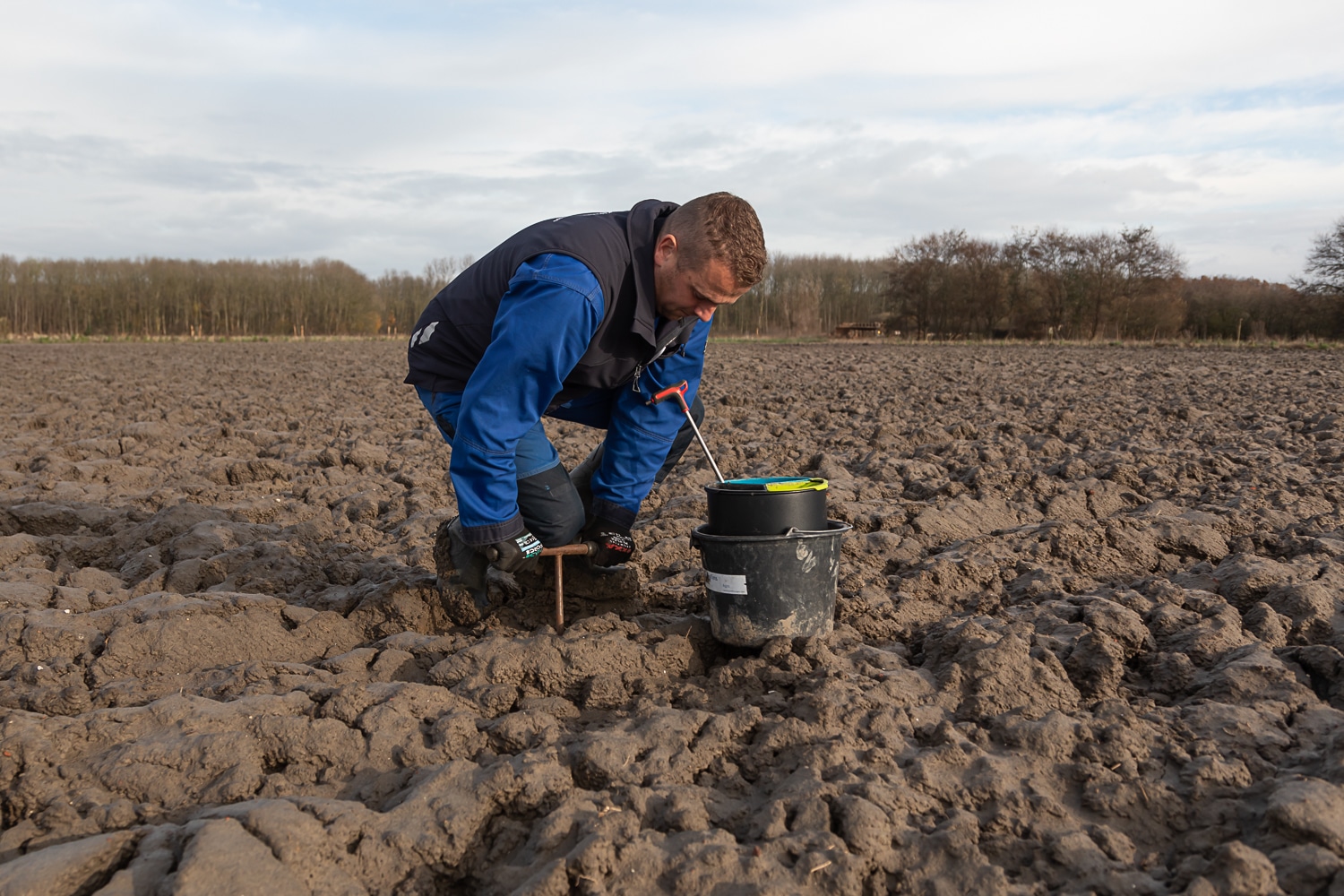
In 2025, the amount of mineral nitrogen in the soil profile was below the applicable threshold value for nitrate leaching on 95% of the sugar beet fields examined, 84% of the chicory fields and 60% of the potato fields. In 2024, these percentages were 98%, 88% and 68% respectively.
| 2025 N-mineral N, median | 2025 % below threshold value | 2024 N-mineral N, median | 2024 % below threshold value | |
| Sugar beet | 29 kg N | 95% | 25 kg N | 98% |
| Chicory | 34 kg N | 84% | 27 kg N | 88% |
| Potatoes | 84 kg N | 60% | 69 kg N | 68% |
The results show that, in many cases, growers are able to cultivate crops with a limited risk of nitrate leaching. Sugar beet and chicory in particular show that they use nitrogen very efficiently, with relatively little nitrogen remaining in the soil. At the same time, differences between crops must be interpreted carefully. The threshold values differ by soil type and groundwater table. This means that differences in the results are not only linked to the crop, but also to the conditions under which the crop is grown and the standards that apply.
| Soil type | Groundwater table class | Threshold value (kg N/ha) |
| Sand | I–III | 150 |
| IV | 109 | |
| Vb | 102 | |
| VI | 95 | |
| VII | 55 | |
| VIII | 47 | |
| Clay | 124 | |
| Loess | 51 |
The threshold values used for this project are based on research by the National Institute for Public Health and the Environment (RIVM) and were established in collaboration with Wageningen University & Research (WUR). No official threshold values have yet been set by the Ministry. The official threshold values are expected to be published during 2026 as part of the outcome-based approach within the 8th Nitrates Directive Action Programme.
Measurements provide additional insights
Within the project, both the amount of mineral nitrogen in the soil profile was measured and a soil nitrogen surplus was calculated based on fertilisation and removal through harvest. The research shows that these two indicators do not always present the same picture. No clear relationship was found between the measured N-mineral values and the calculated soil nitrogen surplus.
This underlines that important soil processes, such as nitrogen mineralisation from soil, manure and crop residues, as well as differences in weather conditions, are not fully reflected in a calculated soil nitrogen surplus. The reliability of such calculations also strongly depends on the quality and completeness of the available cultivation data.
N-mineral measurements as a building block for outcome-based management
The results confirm that N-mineral measurements are a valuable indicator for outcome-based management of water quality. The measurement directly shows how much mineral nitrogen is actually present in the soil profile at the end of the growing season and therefore provides a direct indication of the risk of nitrate leaching. Cosun believes that N-mineral measurements should play an important role in future forms of outcome-based management within the 8th Nitrates Directive Action Programme. By steering on measured results at field level, greater insight is gained into the actual environmental performance of farmers than when looking at calculated indicators.
Link with the Sectoraanpak Nitraat
The outcomes align well with the ambitions of BO Akkerbouw’s Sectoraanpak Nitraat, of which Cosun is one of the 14 members. Within this approach, the arable farming sector is working together to improve water quality and increase nitrogen efficiency at farm level. This autumn, large-scale N-mineral measurements will once again be carried out. This time, they will not be conducted by Cosun, but through BO Akkerbouw’s sector approach, with funding from LVVN. The collected results can contribute to insight, benchmarking and the further development of outcome-based management using factual measurements at field level.
Registration for the free autumn measurements opens on 1 September via www.nminmeting.nl.
Continuing to build water quality together
The results of the N-mineral project show that many growers are already taking important steps towards more efficient nitrogen use and a lower risk of nitrate leaching. By continuing to measure, learn and improve as a sector, we are working together towards sustainable arable farming and achieving water quality objectives.